
Your house, drawn.
The speed in every room.
One clear fix.
Every visit across Geelong, the Surf Coast, the Bellarine, Golden Plains and the Colac and Otway region ends with a written report you keep. Measured numbers, your layout drawn, the reasoning in plain words. $199 flat, GST included, about 90 minutes on site.
Nothing to pay when you book. $199 inc GST on the day. Free reschedule with 24 hours' notice.
The short version.
The first thing on page one is the answer, in a sentence you can repeat to somebody else. Then four numbers: how many rooms we measured, what the line itself does, how many rooms are already fine, and the worst one. If you read nothing else, you have the result.
- ✓ The verdict in one line, before any detail
- ✓ Four numbers, the ones worth remembering
- ✓ The three things we found, one card each
- ✓ A plain-words explanation of the one real problem
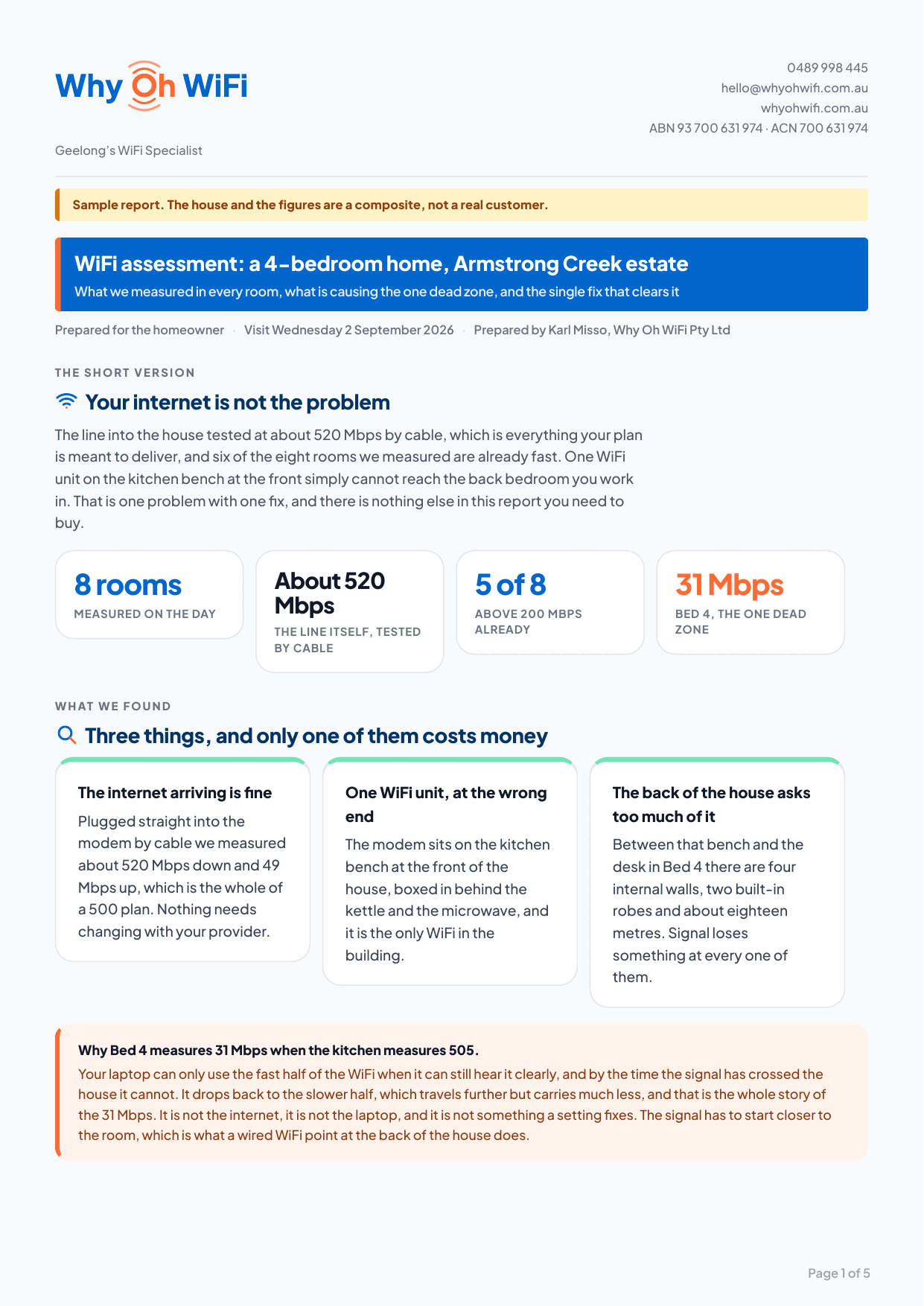
From the sample report. The house and the figures are a composite.
Your house, drawn, with the speed in every room.
Not a stock graphic and not a coloured blur. Your layout, drawn, with the measured download speed written onto each room, the equipment marked where it actually sits, and a key beside it. Rooms we did not test say "not measured" rather than being quietly left blank.
- ✓ The measured number sits on the room, not in a table somewhere else
- ✓ Rooms shaded by the band their figure falls in, not by how they felt
- ✓ Where the equipment is today, and where we would move it
- ✓ Anything we did not test is labelled as not tested
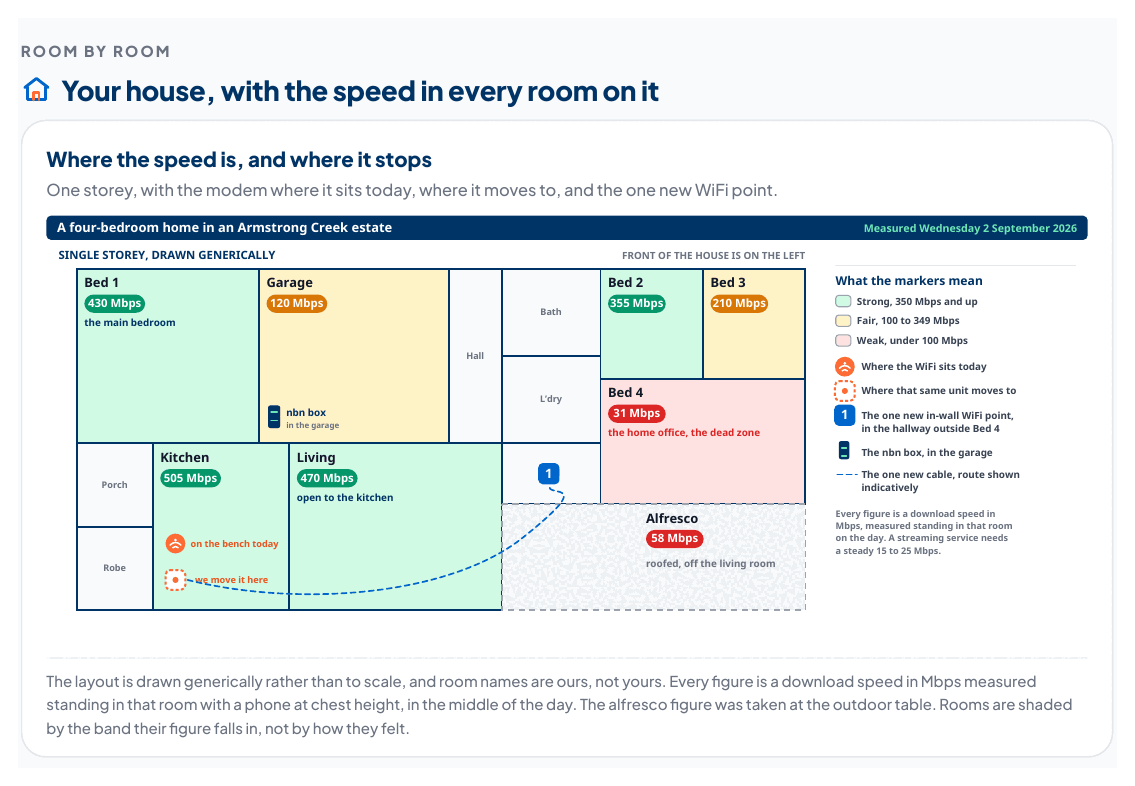
From the sample report. The house and the figures are a composite.
The measurements, drawn to scale.
Every room we tested, as a bar, on one axis. A room at 31 Mbps looks like a room at 31 Mbps next to one at 505. The marker across the chart is what a streaming service actually needs, so you can see at a glance which rooms clear it and by how far.
- ✓ One bar per room, all on the same scale
- ✓ The line for what a streaming service needs, drawn on the chart
- ✓ The multiplier stated as a number, not as an adjective
- ✓ The caveats underneath in small print, never inside the number
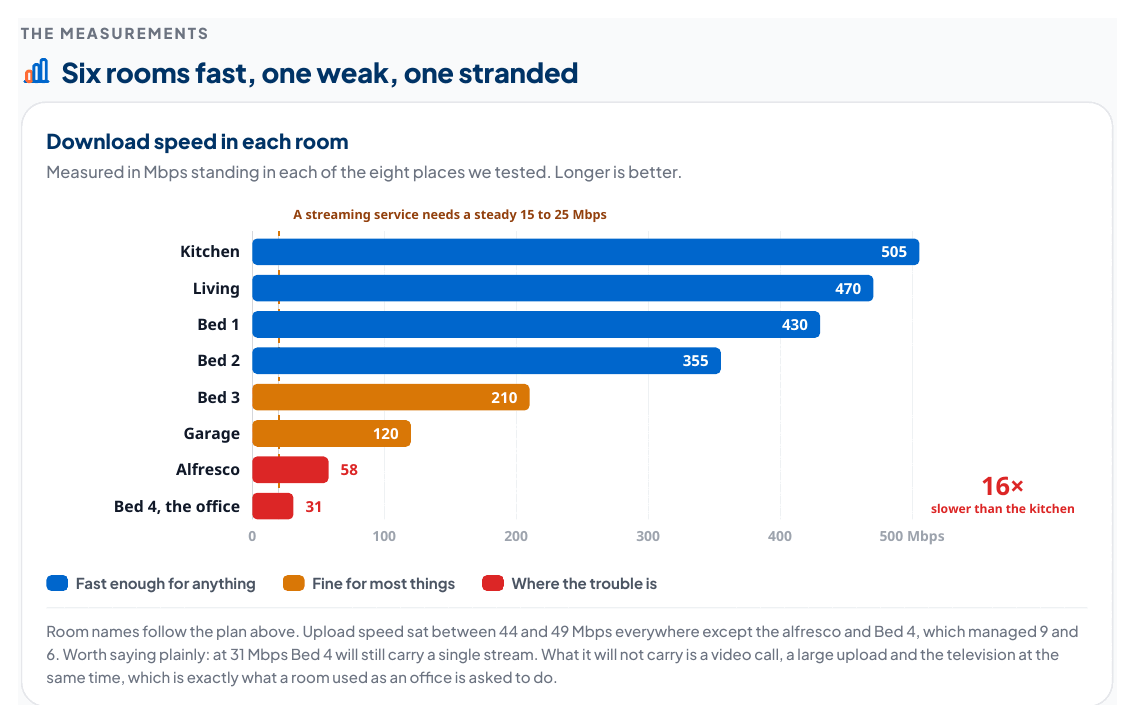
From the sample report. The house and the figures are a composite.
Your equipment: keep, set up, back to you.
Every piece of network gear in the house, with one of three verdicts against it and the reason in plain words. Most rows say keep. Where something goes back to you it is because it is the wrong tool for your house, not because it is broken, and we say which.
- ✓ Keep: it is working and it stays exactly where it is
- ✓ Set up: it stays, and we change something about it
- ✓ Back to you: it comes out, and it is yours to sell or keep
- ✓ A reason against every row, in words you can check
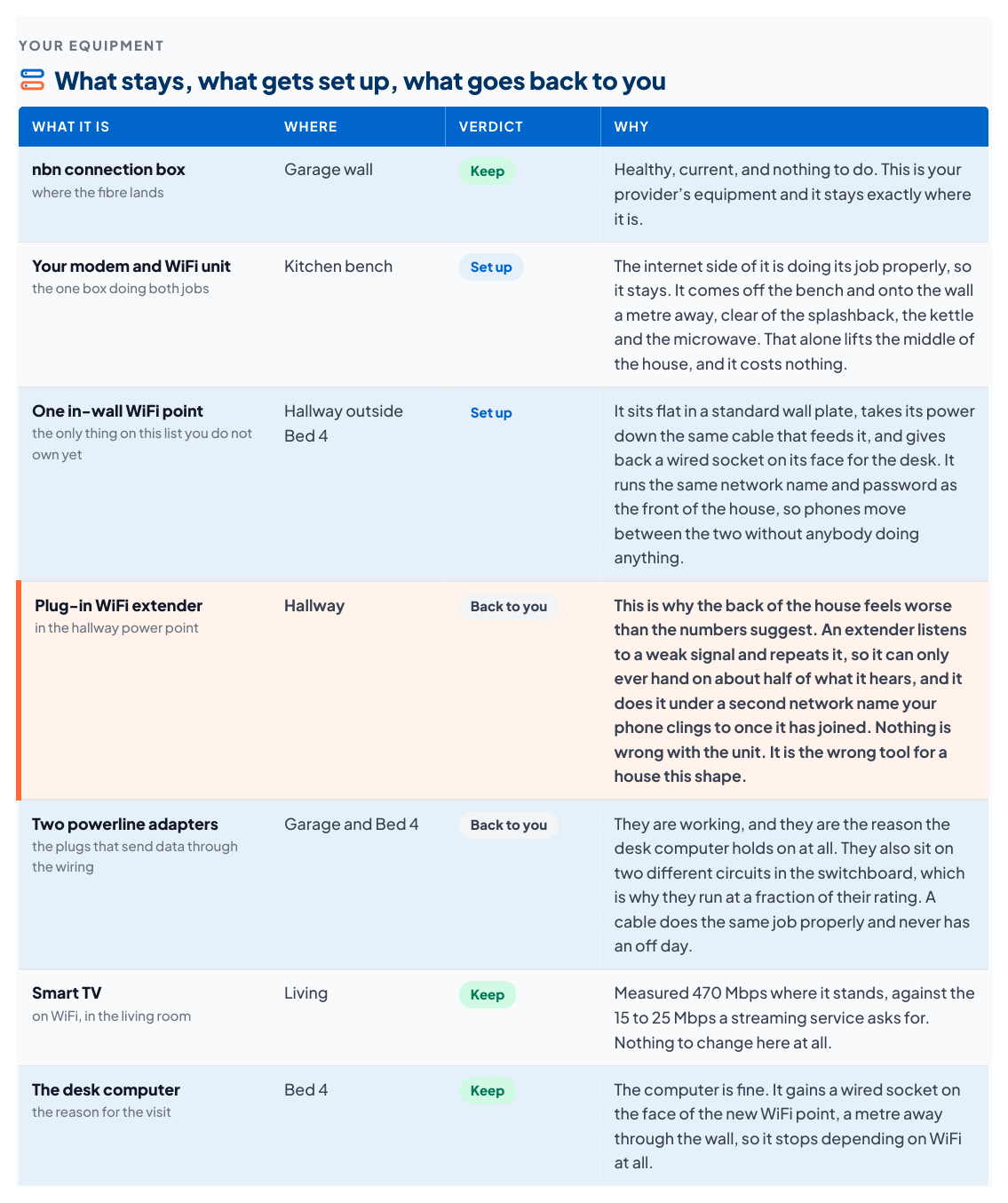
From the sample report. The house and the figures are a composite.
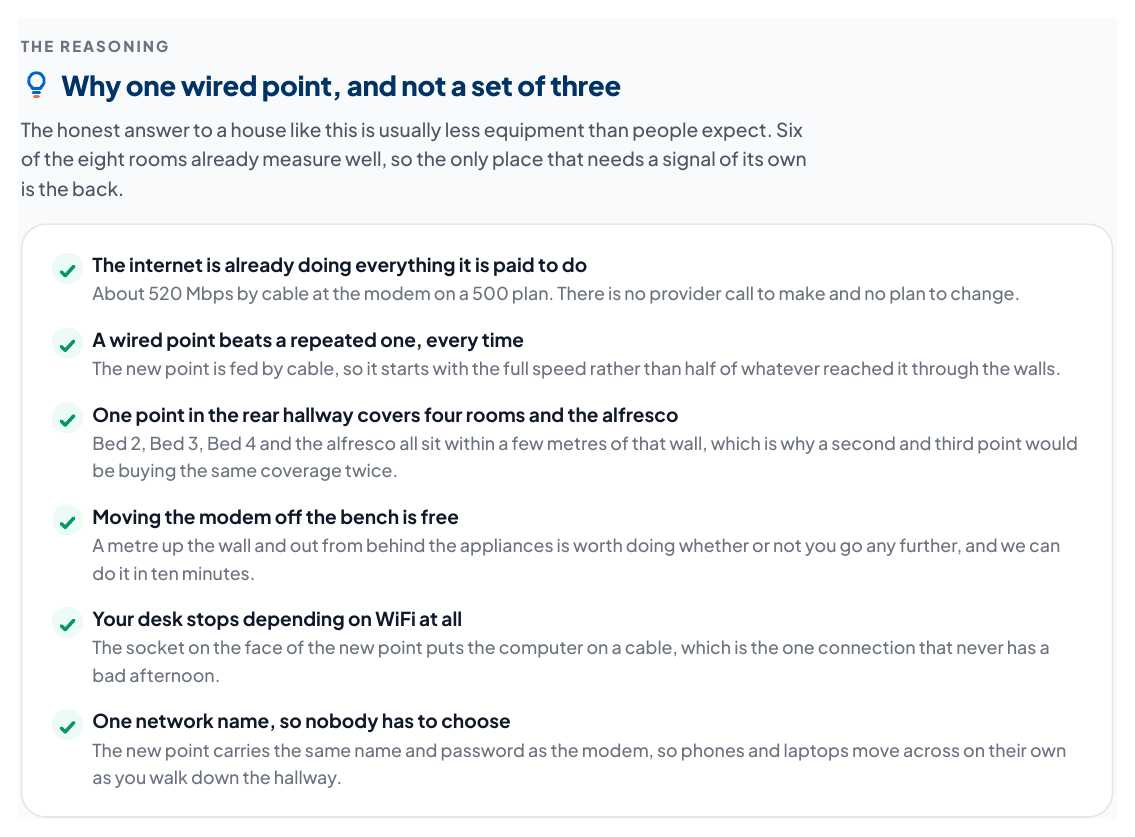
Why, in plain words.
The part most reports leave out. Not just what we recommend but why that and not something else, including why we are not recommending more. If the honest answer is that six of your eight rooms are already fine, the report says so and prices accordingly.
- ✓ Why this fix, and why not the bigger one
- ✓ What the alternative would cost you in performance
- ✓ The free part of the recommendation, called out as free
- ✓ No product names dressed up as reasoning
From the sample report. The house and the figures are a composite.
What happens next.
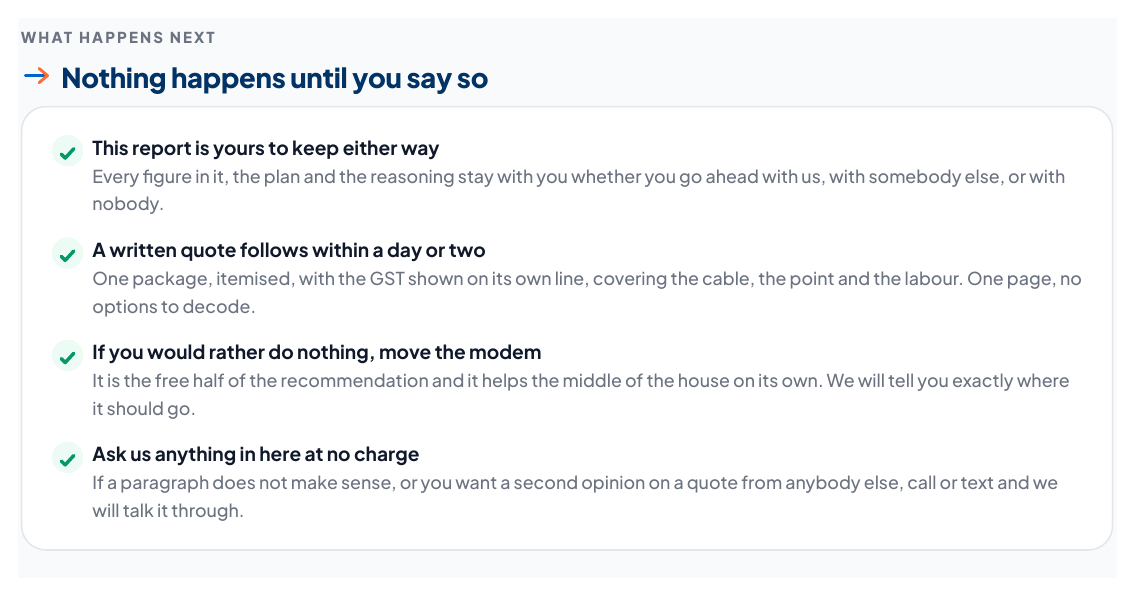
Nothing, until you say so. The report is yours to keep whether you go ahead with us, with somebody else, or with nobody. If a quote follows, it is one package on one page with the GST on its own line, not a tiered menu you have to decode.
- ✓ The report is yours either way
- ✓ One package, itemised, GST on its own line
- ✓ The free half of the recommendation, if there is one
- ✓ Questions about anything in it cost nothing
From the sample report. The house and the figures are a composite.
Things we noticed, outside our trade.
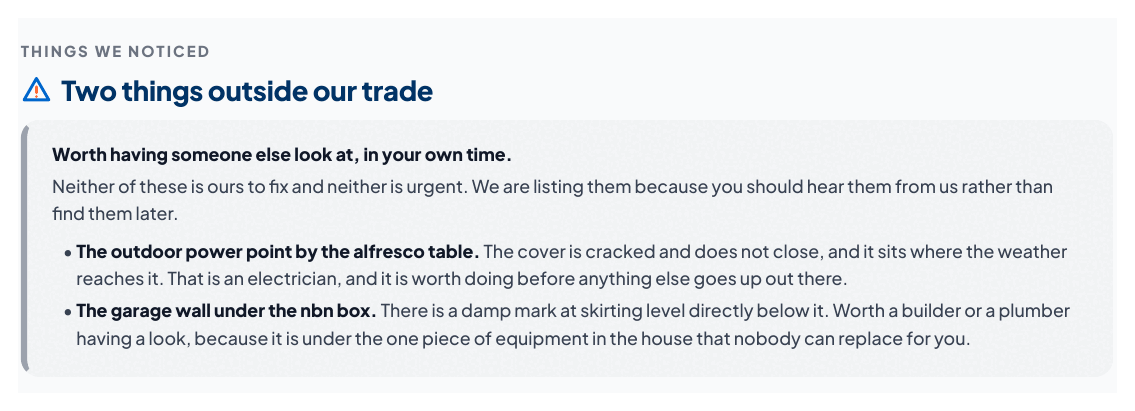
While we are in the roof space and behind the equipment we see things that are not ours to fix. A cracked outdoor power point cover, a damp mark under the nbn box. We list them plainly, we do not charge for them, and we do not pretend they are urgent when they are not.
- ✓ Only what we actually saw, described as we saw it
- ✓ Who it is a job for, if we can tell
- ✓ No scare language, and no quote attached
- ✓ Better you hear it from us than find it later
From the sample report. The house and the figures are a composite.
Two units. Mbps and ×.
A report full of units you have to look up is a report that has moved the work onto you. So there are only two in ours, and everything else is a bar, a picture or a sentence.
Every figure is a download speed, in Mbps
Measured standing in that room, on a phone at chest height, at a stated time of day. Same phone, same spots, so the numbers compare with each other.
What a streaming service needs is 15 to 25 Mbps
That is the yardstick we draw on the chart. It is why a room at 470 Mbps needs nothing done to it, and why one at 31 Mbps still streams but cannot also carry a video call.
We say "16× faster", not a signal reading
Signal strength in decibels is a real measurement and a useless sentence. If a number needs a glossary entry before it means anything, we translate it into a multiple or a bar instead. We still take those readings. They just do not belong in your report.
Caveats sit under the picture, in small print
Where we took two readings, or could not test something, that is written below the chart. The number itself never carries a hedge, because a hedged number is not a measurement.
No upsell. No jargon. No filler.
Every line below is a rule in the deliverable standard we write these to, not a slogan. Some of the most useful things about the report are the things it never contains.
Ready for an actual diagnosis?
$199 flat, GST included. Real measurements, your house drawn, and an honest answer even if that answer is "do nothing".
Nothing to pay when you book. $199 inc GST on the day. Free reschedule with 24 hours' notice.