
Last Tuesday, Australia filled in the Census. All year, we have been quietly running a different one. Every time we visited a home or small business across Geelong, the Surf Coast and the Bellarine, we measured the WiFi, room by room, before we touched anything and again after the work was done. This is what all of those measurements say, and what you can check in your own place tonight without buying a thing.
Why people actually called
Nobody rings us quoting numbers. They ring describing their evening.
The single most common word in our booking notes is dropouts. The video call that freezes at the same point in the hallway. The show that stops to think just as it gets going. The game that lags at the worst possible moment. After dropouts come slow speeds, and close behind that a phrase we hear so often it could be the region’s motto: “it just doesn’t reach the back room.”
And from the small businesses: the card machine that loses its connection at the counter, the booking screen that hangs while a customer waits. A shop does not experience WiFi problems as a technology issue. It experiences them as an awkward silence at the till.
People don’t buy internet. They buy the movie not buffering, the call not dropping, and the card machine working at five o’clock.
First, what do these numbers even mean?
If words like megabits mean nothing to you, you are exactly who this Census is for. Here is the whole thing in one paragraph.
Internet speed is how much can flow to a device each second, measured in Mbps (megabits per second). An email needs almost nothing. A video call needs only a little, but needs it steady. One high-quality Netflix stream wants about 25. A busy family evening, with a couple of TVs, homework, and someone gaming, is comfortable in the low hundreds. Lag (or ping, or latency, all roughly the same idea) is how long after you click before anything happens. Speed is the size of the water pipe; lag is how long you wait for the tap to start flowing.
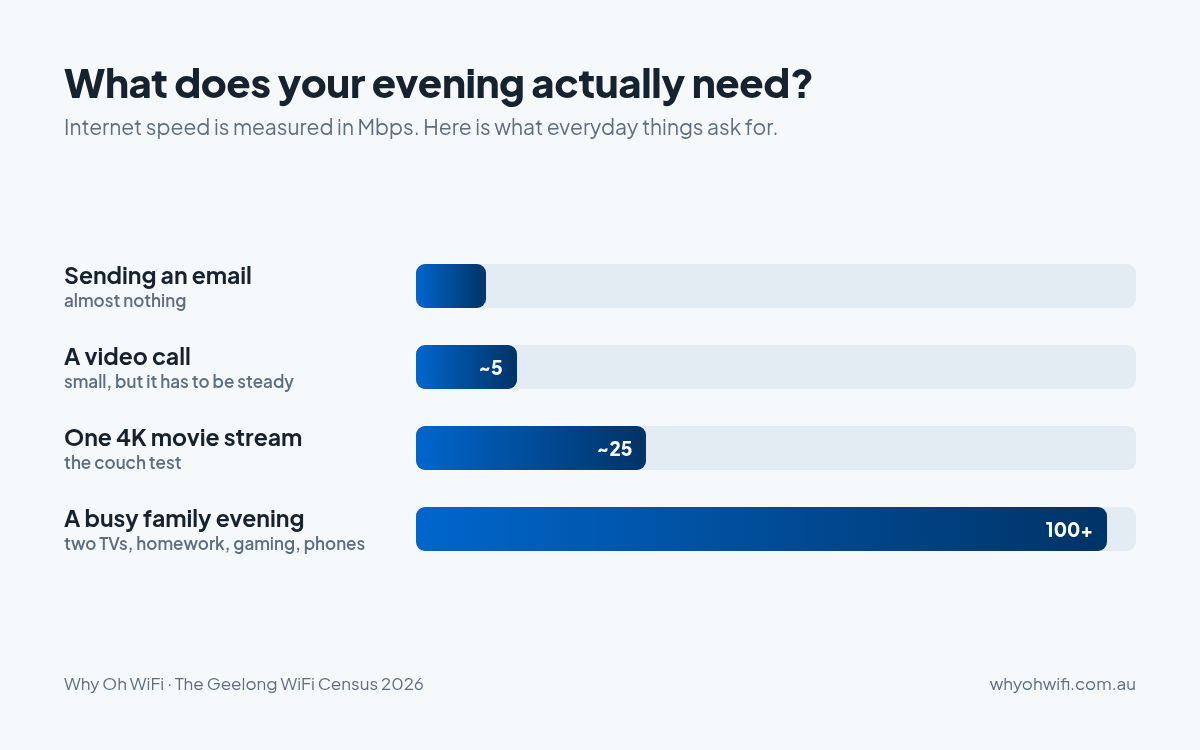
And here is the crucial part almost nobody is told: the speed you pay for is the speed arriving at your house, not the speed reaching your back bedroom. Between the two sits your home: walls, distance, where the equipment lives, and how it is set up. That gap is what this Census measured.
Fewer than one job in ten traced back to the internet line coming into the building. Almost everything wrong with local WiFi is inside the house.
What we found in the rooms
Where we measured the same spot before the work and again after, on the same internet plan, the typical room ended up around four times faster. The rooms that moved furthest were the ones that had nothing to begin with:
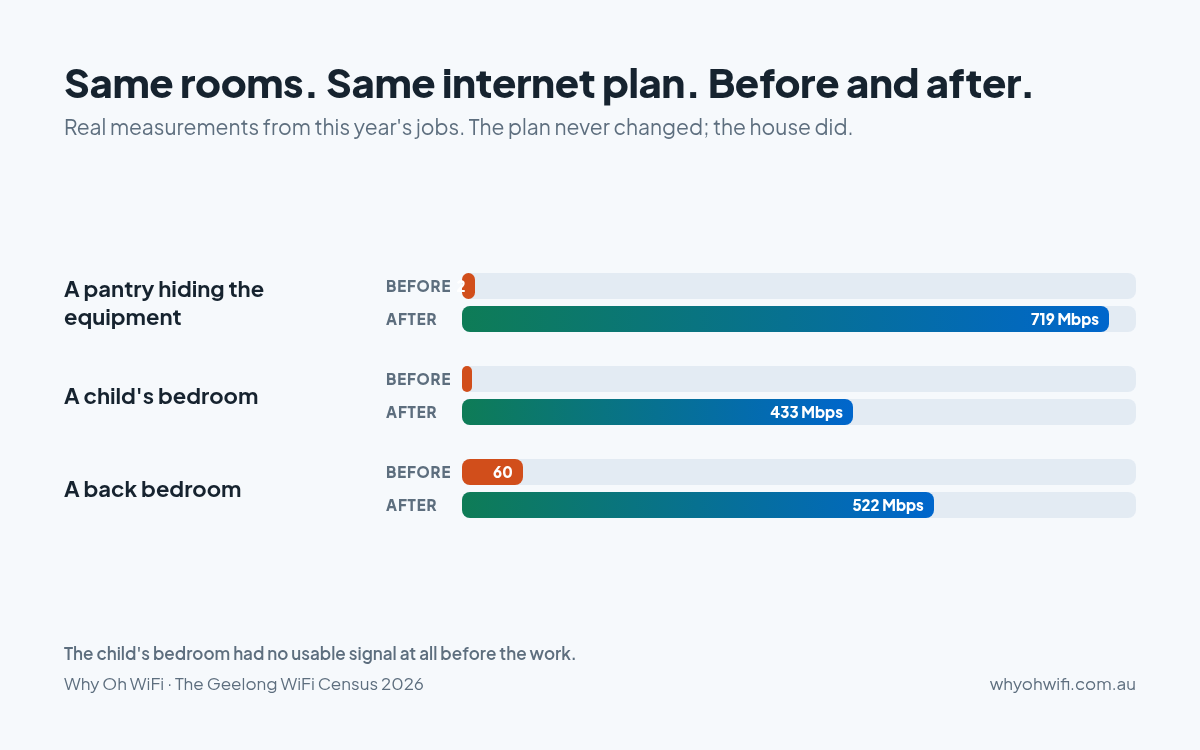
A bedroom that started with no signal at all came back at 167 Mbps. A room that had only ever been described as “weak and dropping out” came back at 441. Same houses, same internet plans.
Some of the rooms we measured had no usable WiFi at all, including a child’s bedroom. Several more were so bad that nobody had ever bothered putting a number on them; the records just say “weak”, “patchy”, “dropping out”. In plain terms: before the work, those rooms could not hold a video call. After it, any of them could stream in 4K with room to spare.
What does four times faster feel like? It is the difference between a movie that buffers twice before the title screen and one that just plays. Between “you’re frozen, we can’t hear you” and a whole call where nobody mentions the internet. That is what people are actually buying. Not equipment. Evenings that work.
Two of this year’s customers said it better than we can. Both reviews are public on Google:
We called Karl after having issues with WiFi throughout the house, some rooms were good and some terrible. We are now getting amazing speeds in every-room and on every device.
He managed to utilize my existing hardware (Google nest) and quadrupled the speed & stabilized the signal.

A real coverage map from a recent local job, anonymised. This is what “measured room by room” looks like: every room tested, every speed on the map, including the gym across the garden.
The part that surprises everyone
Almost half the homes we worked on had more than one separate thing wrong at once. That is why the gadget you bought did not fix it: solving one problem out of three feels like nothing changed. The usual suspects, roughly in order: where the equipment is sitting (the biggest cause by a wide margin, and the pantry above is why), a house that simply needs more than one WiFi point, settings that were never right, tired old gear, and an extender quietly making everything worse.
And the honest number a WiFi business probably should not publish: one job in five was fixed without buying anything at all. The equipment was fine. It was in the wrong place, or fighting a leftover network that should have been switched off, or set up wrong on day one.
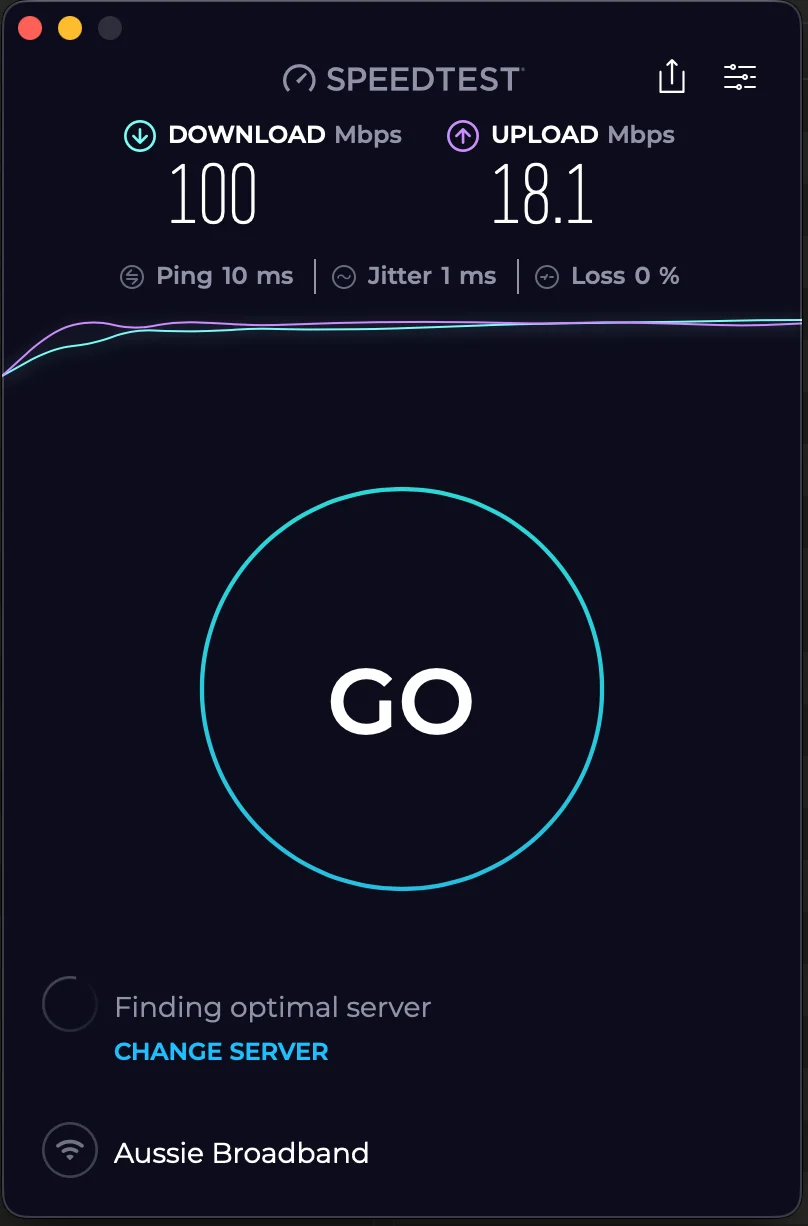 This is the whole technique: test in the room that annoys you, then beside the router, and compare.
Stand in the room that annoys you, at the time it annoys you, and run a speed test on your phone (search “speed test”, tap go). Then run the same test standing next to your router. If the numbers are wildly different, your internet is fine and your WiFi is the problem. That single comparison is more useful than anything your provider’s help line will ask you to do.
The free fibre upgrade catch
If your street gets the free nbn upgrade to full fibre, take it: the speed arriving at your house genuinely improves. But watch where the installer puts the new connection box. We have measured homes where the upgrade moved the internet’s entry point from the middle of the house to a far corner, and the WiFi got worse while the plan got faster, because the whole network was suddenly anchored in the wrong place. Faster internet into the wrong corner is still the wrong corner.
Who we are, and how this was measured
Why Oh WiFi is a Geelong business that does one thing: finds out why WiFi is bad and fixes it. For this Census we went back through every job across Geelong, the Surf Coast and the Bellarine throughout the year: hundreds of room-by-room measurements across dozens of homes and small businesses, with the same spots measured before and after the work. Where a room’s “before” was recorded only in words, we left it out of every average. All of it is anonymised, and every figure here is a floor, not a ceiling.
One honest caveat: these are homes that called us because something was wrong. This is not a random survey of the region. It is a detailed picture of what bad WiFi looks like around here, and of how fixable it turns out to be.
Common questions
Is slow WiFi my internet provider's fault?+
Usually not. In the jobs behind this Census, the line coming into the building was the recorded cause in fewer than one in ten cases. The most common causes were all inside the house: where the equipment sits, how much of the house it can reach, and how it is set up.
Will a WiFi extender from the shops fix my dead spot?+
Sometimes, but extenders were actively making things worse in a meaningful share of the jobs we analysed. An extender re-sends the signal over the same airwaves, so you often get half the speed, plus a second network your phone can latch onto and refuse to let go of.
Do I need to buy new equipment?+
Not always. One job in five in this Census was fixed with no new hardware at all: moving the router, switching off a leftover network, removing an extender, or correcting settings. It is worth having someone measure before you buy anything.
Would a faster internet plan help?+
If your problem is one bad room, almost certainly not. A faster plan means more speed arriving at a box that still cannot reach the back bedroom. Fix the reach first, then decide if you need the speed.
How do I know which room to test?+
The one that annoys you, at the time of day it annoys you. Test there, then test beside your router, and compare. A big gap between the two numbers means the WiFi, not the internet, is your problem.
If your place has a room like these
Every home in this Census started with someone deciding the problem was worth an hour of measuring. That is the whole first step: a $199 assessment where we measure every room, show you exactly what is happening with a coverage map, and give you a written plan in plain English. Sometimes the plan is “move one box and change two settings”, and that is the whole fix.